
Why Choose 3M Window Tint?
With dozens of window tint brands on the market, why do professional shops — and informed consumers — consistently choose 3M? It comes down to engineering, warranty, and a track record that spans decades.
A Brief History of 3M in Window Film
3M (Minnesota Mining and Manufacturing) has been developing film technology since the 1960s. They pioneered many of the core technologies used in modern window films, including multilayer optical film, nano-ceramic particle integration, and colour-stable carbon formulations. When other brands launched their versions of “ceramic” or “carbon” films, they were following paths 3M had already established.
Today, 3M’s automotive division supplies window film to dealerships, fleet operators, and professional installers worldwide. Their films are manufactured in climate-controlled facilities with tolerances measured in microns.
What Makes 3M Different from Cheaper Brands?
Engineering and Materials
Budget tint brands use basic dyed polyester films. The dye absorbs light (creating the dark appearance) but breaks down under UV exposure — hence the inevitable purple fading. 3M’s films use fundamentally different technology: nano-carbon particles (Colour Stable), ceramic particles (Ceramic IR), or multilayer optical films (Crystalline) that filter light through physical structure rather than dyes.
The Lifetime Warranty
3M provides a lifetime manufacturer’s warranty on all three of their automotive film grades. This covers bubbling, peeling, cracking, demetallizing, and colour change. Most budget brands offer 1-3 year warranties — and many don’t honor them. 3M’s warranty is backed by a company with $35 billion in annual revenue. They’re not going anywhere.
Non-Metallized Construction
Older window films used metal layers to reflect heat. While effective, metallic films interfere with cell signals, GPS, Bluetooth, satellite radio, toll transponders, and increasingly, ADAS sensors (lane departure, collision avoidance). All three 3M automotive grades are completely non-metallized — zero signal interference.
Consistency
Every roll of 3M film meets the same specifications, every time. The VLT is accurate, the colour is consistent, and the performance matches the datasheet. With budget brands, you might get a 35% VLT film that actually measures 28% — a difference that could put you on the wrong side of Alberta’s tint laws.
The Three 3M Automotive Grades
3M Carbon (Colour Stable)
The entry point to professional-grade tint. Uses nano-carbon technology for durability and colour stability. Starting at $299 for 2 front windows.
3M Ceramic IR
Our most popular film. Advanced ceramic particle technology for superior heat rejection. Starting at $349 for 2 front windows.
3M Crystalline
The pinnacle. Over 200 layers of optical film for maximum heat rejection with near-clear appearance. Starting at $599 for 2 front windows.
Compare all three in detail on our tint comparison page, or view current pricing.
What is Window Tinting, Really?
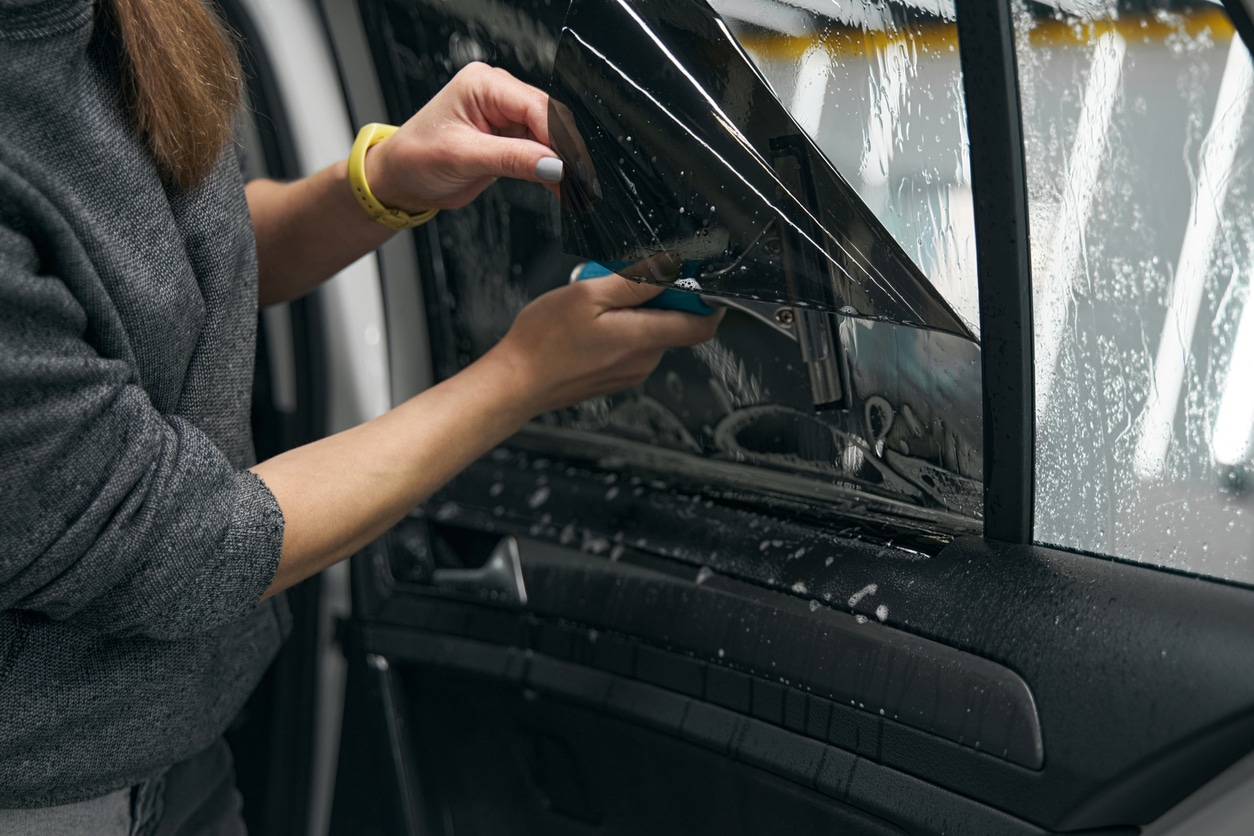
For those new to the topic: automotive window tinting is the application of a thin, transparent film to the interior surface of your vehicle’s glass. The film is precision-cut to match each window’s shape and adhered using a pressure-sensitive adhesive. Once cured, the film becomes a permanent part of the glass that provides UV protection, heat rejection, glare reduction, and privacy.
Modern window films are a far cry from the cheap, bubbling tints of the 1990s. Today’s premium films like 3M’s lineup are virtually invisible on the glass, don’t interfere with electronics, and last the lifetime of the vehicle. Learn more about the benefits of window tinting.
Why Pro Window Tinting Chose 3M
We’ve been installing window tint in Calgary for years, and we’ve worked with multiple film brands. We chose to exclusively carry 3M because it’s the product we’d put on our own vehicles. The quality is consistent, the warranty is ironclad, and our customers stay satisfied for years after installation. Contact us to experience the 3M difference.